Python Package

ManifestGuard Python

Python quality gate with AI-ready refactor planning, CI-friendly reports, and dependency checks.

Early Access: Until 2026-12-31

Features

Manifest & packaging validation

Check pyproject/setup/requirements consistency and catch common packaging pitfalls before release.

pyproject.tomlrequirements.txtEntry points

Entry point & dependency checks

Detect broken script targets, missing dependencies, and version conflicts in a single run.

Entry pointsDependenciesConflicts

Policy enforcement

Apply package allow/block rules and version constraints from plain configuration.

PoliciesRulesConfig

Extended analysis

Add extra quality signals such as complexity, duplication, dummy code, and coverage-related metrics.

ComplexityDuplicationCoverage

Reports & SBOM basics

Write machine-readable reports and assess SBOM and license completeness. SPDX and CycloneDX are standard formats for these dependency inventories.

ReportsSBOMEvidence

QuickFix with backup

Preview supported fixes first, then let ManifestGuard write only registered supported patches after creating a workspace snapshot and per-file backups where your license allows it.

QuickFixBackupSafe apply

AI-ready guardrails

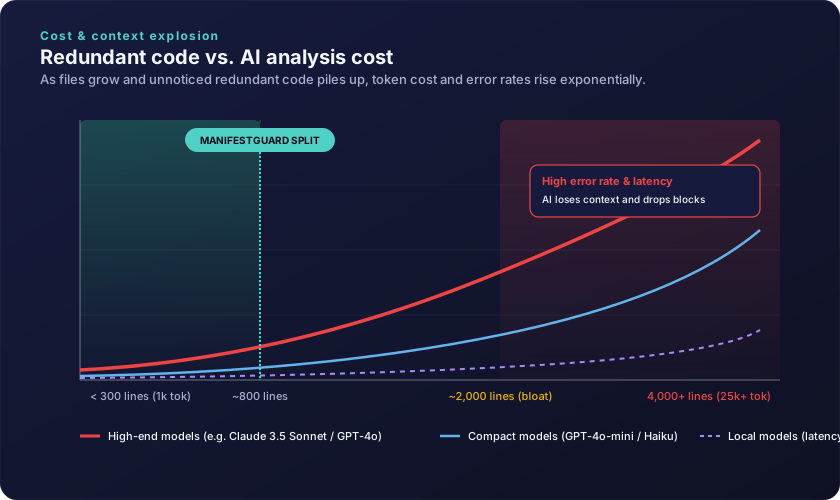
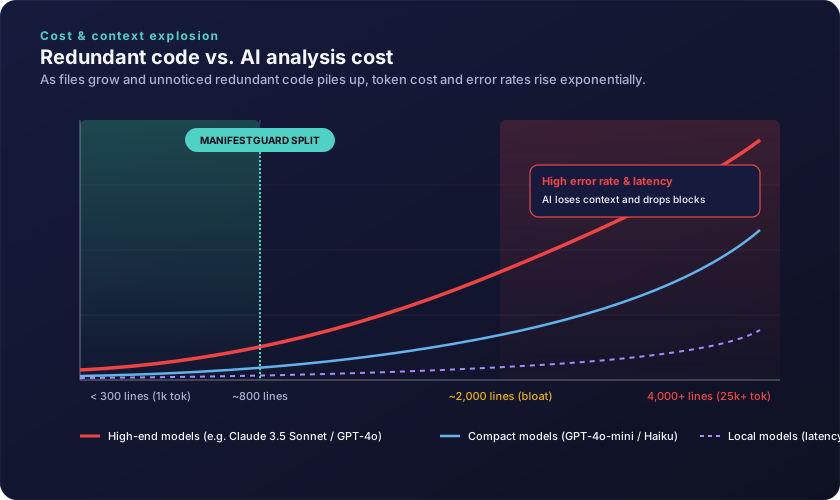
In the age of AI, programming sounds easy — until a module quietly grows to 4,000–7,000 lines, duplication creeps in, and forgotten dummy / placeholder code piles up. Then every fix takes longer, and the risk increases that an AI ‘simplifies’ by removing tested code paths — you notice it too late, and the day is gone.

ManifestGuard is my senior-engineer quality radar for Python projects: it scans structure, packaging, dependencies and policy rules, flags risks (SBOM/compliance gaps included), and shows what to fix — without sugarcoating.

Goal: clarity, not punishment. One command — and you know how healthy your project really is.

ManifestGuard Python (MGPY)

ManifestGuard Python is a CLI quality gate for Python repositories. It helps teams keep code quality measurable and repeatable across local development and CI pipelines.

What it checks

  • Complexity budgets (for functions, classes, and modules)
  • Code duplication patterns across the project
  • Dependency risk and update visibility
  • Refactor-plan baselines with always-on AI hints
  • Machine-readable reports suited for CI validation and release gates
  • Structured quality outputs for pipeline gates

Dashboard surfaces

  • manifestguard dashboard remains the baseline TUI workflow surface
  • The local desktop dashboard is included from Pro upward
  • No separate shared/team web dashboard is planned currently because it would require shared storage/repository aggregation and there is no current customer demand

Getting started & activation

  • Requirements: The documented default path uses Python 3.12 with pip; on Windows typically via py -3.12, on Linux/macOS typically via python3.12.
  • Project versions: Independent of the interpreter used to run mgpy, the tool can analyze Python projects, packaging metadata and tool targets for target versions from 3.8 to 3.12; the mgpy runtime itself is currently validated on Python 3.10 to 3.13.
  • Runtime libraries: A standard pip installation pulls in the required runtime packages automatically: tomlkit, click, pydantic, packaging, watchdog, PyNaCl, and rfc8785; only Python versions below 3.11 additionally require tomli.
  • Start with Installation & Download for the concrete download, install, and setup path.
  • Install user-wide with py -3.12 -m pip install --user manifestguard; pin a fixed release with py -3.12 -m pip install --user "manifestguard==<VERSION>".
  • After purchase, sign in in the customer area at /login and then move to /license/activate.
  • There, enter the license key and the local device hash from py -3.12 -m manifestguard license device-hash, then copy the activation token returned by the portal.
  • Activate locally with py -3.12 -m manifestguard license activate <TOKEN> and verify with py -3.12 -m manifestguard license status; the same token can later be reused in MGVS.

Workflow fit

Run checks locally before commit, then enforce the same criteria in CI. MGPY is designed for deterministic test behavior and unattended execution. CLI commands and machine-readable output make it suitable for release gates and team policy checks. A dedicated refactoring rules manifest keeps AI-assisted refactor guidance explicit and repeatable.

Goal: clarity, not punishment. One command gives a concrete quality status you can act on.

Overview

Columns
Manifest & packaging validation
Entry point consistency checks
Dependency analysis
Custom validation rules
Extended analysis
QuickFix suggestions
QuickFix apply (supported findings + backup)

Licensing

Early Access (until 2026-12-31)

Columns
Community
1
€0
Trial (14 days)
2
€0
Pro
2
€99€149/year
Team (bundles)
25+
€399–€999/year (Team 5/10) Coming soon
Enterprise (packs)
Custom
€3,990–€5,990/year (Enterprise 100) Coming soon

Applies to the purchased version incl. all updates for 1 year from the purchase date.